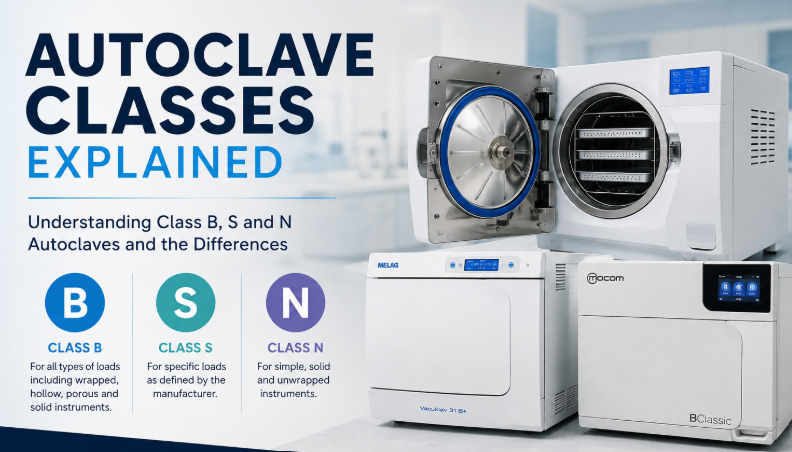
If you’re looking to buy an autoclave for a medical, dental or healthcare practice, you’ll quickly come across terms like Class B, Class S and Class N.
But what do these classes actually mean?
Choosing an autoclave isn’t simply about picking a machine with the biggest chamber or the most features. Different autoclaves are designed to handle different types of instruments and loads. Understanding the difference between the classes can help you choose a steriliser that is suitable for your practice and the instruments you use every day.
At HTC Medical, we supply, service and support autoclaves from established manufacturers, including MELAG, Mocom and other leading sterilisation brands. In this guide, we’ll explain the main autoclave classes and what you should consider before buying one.
What Is an Autoclave?
An autoclave, also known as a steam steriliser, uses high-temperature steam under pressure to sterilise equipment and instruments.
Steam sterilisation is widely used in healthcare because it can effectively destroy microorganisms, including bacteria, viruses and bacterial spores, when the correct temperature, pressure and exposure time are achieved.
The CDC’s guidance on steam sterilisation explains why steam is one of the most commonly used methods for sterilising heat- and moisture-resistant medical instruments.
However, not every autoclave works in exactly the same way. This is where the different classes come in.
What Are Class B, Class S and Class N Autoclaves?
Class B, S and N are classifications used for small steam sterilisers under EN 13060.
The main difference between them is the type of load they are designed to sterilise and how they remove air from the chamber and the instruments.
In simple terms:
- Class B: Designed for a wide range of loads, including wrapped, hollow and porous instruments.
- Class S: Designed for specific loads determined by the manufacturer.
- Class N: Generally intended for simple, solid and unwrapped instruments.
It’s worth pointing out that Class B doesn’t automatically mean that a Class S or Class N machine is poorly designed or unsuitable. The important question is whether the autoclave is capable of handling the instruments and loads your practice needs to process.
Class B Autoclaves
For many medical and dental practices, Class B is the most versatile option.
Class B autoclaves use a vacuum process to remove air from the chamber before steam is introduced. Removing air is important because steam needs to reach all areas of the load to achieve effective sterilisation.
Because of their vacuum system, Class B autoclaves can generally handle a much wider range of loads.
These can include:
- Wrapped instruments
- Unwrapped instruments
- Solid instruments
- Hollow instruments
- Porous materials
- More complex instruments with internal channels
This makes Class B autoclaves a popular choice for practices that use different types of instruments throughout the day.
For example, a dental practice may need to sterilise handpieces and other hollow instruments as well as packaged instruments. A Class B machine can provide the flexibility needed for these different loads, provided they are within the manufacturer’s specified capabilities.
Why Choose a Class B Autoclave?
The biggest advantage is versatility.
If your practice processes a variety of instruments and you don’t want to be restricted by the types of loads your steriliser can handle, Class B is worth considering.
Class B machines can also provide effective drying, which is particularly useful when instruments are sterilised in packaging and need to remain dry after the cycle.
Class S Autoclaves
Class S autoclaves sit somewhere between the capabilities of Class B and Class N, although it’s important not to think of them simply as a “middle class.”
The main point with Class S is that the exact load types depend on the individual machine and the manufacturer’s specifications.
A Class S autoclave may be designed to process certain solid instruments, packaged instruments or specific hollow loads. However, you can’t assume that one Class S machine will have the same capabilities as another.
If you’re considering a Class S autoclave, always check the manufacturer’s instructions to see exactly what it has been designed to sterilise.
This is one reason why getting advice from an experienced supplier can be useful before purchasing.
Class N Autoclaves
Class N autoclaves are generally intended for solid, unwrapped instruments.
They use gravity displacement to remove air from the chamber rather than the more advanced vacuum process found in Class B systems.
Because of this, Class N machines have more limited applications.
They’re generally not suitable for sterilising:
- Wrapped instruments
- Porous loads
- Hollow instruments
- Complex instruments with internal channels
For a practice that only needs to sterilise simple, solid instruments immediately before use, a Class N autoclave may be suitable.
However, if you need to sterilise and package instruments for later use or regularly process hollow instruments, you’ll generally need a steriliser with greater capabilities.
Class B vs Class S vs Class N: What’s the Difference?
Here’s a simple comparison:
| Feature | Class B | Class S | Class N |
|---|---|---|---|
| Solid instruments | ✓ | Depending on model | ✓ |
| Unwrapped instruments | ✓ | Depending on model | ✓ |
| Wrapped instruments | ✓ | Depending on model | ✗ |
| Hollow instruments | ✓ | Depending on model | ✗ |
| Porous loads | ✓ | Depending on model | ✗ |
| Vacuum system | ✓ | Model dependent | ✗ |
| Load flexibility | High | Model dependent | Limited |
| Best suited for | Wide range of instruments | Specific loads | Simple solid instruments |
Important: This is a general comparison. Always check the manufacturer’s specifications and instructions for use before deciding whether a particular autoclave is suitable for your instruments.
Why Does Air Removal Matter?
One of the biggest differences between autoclave classes comes down to air removal.
Think about trying to sterilise the inside of a hollow instrument. If air remains trapped inside it, steam may not be able to reach every surface properly.
A vacuum system helps remove air before steam enters the chamber. This allows steam to penetrate areas that would otherwise be difficult to reach.
This is one of the reasons Class B autoclaves are commonly used in practices that deal with hollow, porous or wrapped instruments.
The CDC’s steam sterilisation guidance provides further information on the importance of steam contact and the sterilisation process.
Popular Autoclave Brands
When researching autoclaves, you’ll come across a number of manufacturers. At HTC Medical, we work with established brands and help practices find equipment that matches their requirements.
MELAG
MELAG is a German manufacturer well known for its medical and dental sterilisation equipment.
Its range includes Class B and other types of autoclaves designed for different applications. MELAG is particularly well known for its premium tabletop sterilisation systems and infection-control equipment.
You can learn more about the manufacturer’s sterilisation equipment on the official MELAG website.
Mocom
Mocom specialises in dental equipment and sterilisation systems.
The company’s range includes Class B autoclaves designed for dental practices, with models offering features such as touchscreen controls, automated cycles and connectivity.
Visit the official Mocom website to explore its range of sterilisation equipment.
Tuttnauer
Tuttnauer is another established manufacturer of sterilisation equipment, with products used across dental, medical and laboratory environments.
Its range includes different tabletop autoclaves designed for various applications and load requirements.
More information is available through the official Tuttnauer website.
Which Autoclave Class Should You Choose?
There’s no single answer that works for every practice.
The right autoclave depends on the instruments you use and how you process them.
Before purchasing, consider the following:
What instruments do you sterilise?
Make a list of the instruments your practice regularly processes. Are they solid, hollow, porous or packaged?
The answer can immediately narrow down which autoclave classes are suitable.
Do you use wrapped instruments?
If you sterilise instruments in pouches or other packaging, make sure the autoclave is specifically designed and validated for those loads.
Do you use hollow instruments?
Dental handpieces and other instruments with internal channels can require more effective air removal and steam penetration.
If these instruments are part of your regular workflow, a Class B autoclave may be the better choice.
How many instruments do you process?
Chamber size is another important consideration.
A small practice with relatively low instrument volumes may have different requirements from a busy dental or medical clinic processing multiple loads throughout the day.
What does the manufacturer recommend?
Don’t rely on the class name alone.
Always check the specific model’s instructions for use and technical specifications. Two autoclaves within the same broad class can have different features, cycle options and load limitations.
Buying a New or Refurbished Autoclave
If you’re working with a limited budget, you don’t necessarily have to purchase a brand-new machine.
A professionally refurbished autoclave can be a practical alternative, particularly when the machine has been properly inspected, serviced and tested.
However, it’s important to know what you’re buying.
Before purchasing a refurbished autoclave, ask about:
- Service history
- Previous usage
- Condition of the chamber
- Door seal condition
- Vacuum pump performance
- Heating system
- Cycle performance
- Availability of spare parts
- Warranty
- Service and technical support
- Validation or testing documentation
A refurbished autoclave should not simply be sold because it powers on. It should be properly assessed to ensure it is suitable for continued use.
Don’t Forget About Autoclave Servicing and Validation
Buying the right autoclave is only the beginning.
Regular servicing and testing help identify problems before they affect the sterilisation process. Depending on the equipment and applicable requirements, practices may also need appropriate testing and validation of their sterilisation processes.
At HTC Medical, we provide autoclave servicing, repair, maintenance and validation services to help healthcare practices keep their sterilisation equipment operating reliably.
Our team can also help businesses understand their equipment requirements when purchasing new or refurbished autoclaves.
Final Thoughts
Understanding the difference between Class B, Class S and Class N autoclaves can make the purchasing process much easier.
If you need maximum flexibility for different types of instruments, including wrapped, hollow and porous loads, Class B is generally the most versatile choice.
Class S machines can be suitable for specific applications, but their capabilities need to be checked against the manufacturer’s specifications. Class N machines are more limited and are generally intended for simple, solid, unwrapped instruments.
Brands such as MELAG, Mocom and Tuttnauer offer a variety of sterilisation solutions, giving practices plenty of options depending on their requirements and budget.
At HTC Medical, we can help you compare your options and find an autoclave that suits your practice, whether you’re looking for a new autoclave, refurbished autoclave, autoclave repair, servicing or validation.
If you’re unsure which class is right for your practice, get in touch with HTC Medical before making your purchase. Choosing the right steriliser from the start can save you time, money and unnecessary headaches later.