If you operate a medical practice, dental clinic, laboratory, veterinary facility, or other setting that uses reusable instruments, understanding the Australian standards for autoclaves is essential. Proper sterilisation is not simply about owning a reliable autoclave machine. The equipment, reprocessing procedures, maintenance, documentation, staff training, and validation all need to work together to achieve safe and consistent results.
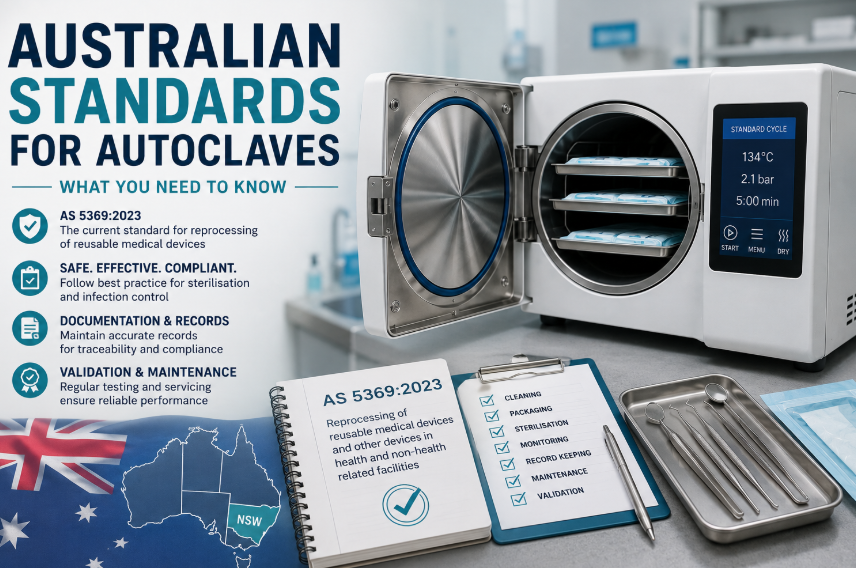
In Australia, AS 5369:2023 Reprocessing of reusable medical devices and other devices in health and non-health related facilities is now the key standard covering the reprocessing of reusable medical devices. It replaced older standards including AS/NZS 4187:2014 and AS/NZS 4815:2006.
For businesses in New South Wales, these requirements are particularly important because NSW Health states that reusable instruments used in skin penetration procedures must be sterilised in accordance with AS 5369:2023.
What Is AS 5369:2023?
AS 5369:2023 is the Australian Standard covering the safe and effective reprocessing of reusable medical devices and other devices used in healthcare and non-healthcare settings.
Rather than focusing only on the autoclave itself, the standard takes a broader approach to the entire reprocessing process. This includes cleaning, disinfection, packaging, sterilisation, storage, handling, and transportation of reusable devices.
The Australian Commission on Safety and Quality in Health Care identifies AS 5369:2023 as the national standard used by health service organisations when implementing requirements for the reprocessing of reusable medical devices.
This means purchasing an Australian-compliant autoclave is only one part of achieving an appropriate sterilisation process.
Has AS 5369:2023 Replaced the Older Autoclave Standards?
Yes. AS 5369:2023 superseded AS/NZS 4187:2014 and AS/NZS 4815:2006 in December 2023.
AS/NZS 4815:2006 previously covered reprocessing in office-based healthcare facilities, while AS/NZS 4187:2014 focused on reusable medical devices in healthcare services. AS 5369:2023 brings these requirements together under a broader framework that also covers relevant non-healthcare facilities.
For healthcare businesses that previously followed the older standards, transitioning to AS 5369:2023 is an important part of keeping their reprocessing procedures current.
What Does AS 5369:2023 Cover?
The standard addresses multiple stages of the reprocessing process rather than just the sterilisation cycle.
Key areas include:
- Cleaning and preparation of reusable devices
- Disinfection
- Inspection and preparation
- Packaging systems
- Sterilisation
- Drying
- Storage
- Handling
- Transportation
- Documentation and traceability
- Equipment maintenance
- Validation and monitoring
This approach is important because sterilisation cannot be considered in isolation. An instrument that has not been properly cleaned or packaged may not be effectively sterilised even when the autoclave completes its programmed cycle.
What Does This Mean for Autoclave Machines?
An autoclave must be appropriate for the type of instruments and loads being processed and operated according to the manufacturer’s instructions and applicable reprocessing requirements.
For steam sterilisation, factors such as time, temperature, pressure, steam penetration, loading, packaging, and drying all matter.
NSW Health, for example, states that sterilisation of reusable skin penetration instruments must be carried out using a steam-under-pressure benchtop autoclave in line with AS 5369:2023.
The machine should also be maintained and monitored so that it continues to perform as intended.
What Are the Sterilisation Requirements in NSW?
NSW has specific requirements that businesses need to understand, particularly facilities performing skin penetration procedures.
Under the NSW Public Health Regulation 2022, reusable instruments that penetrate a person’s skin must be sterilised in accordance with AS 5369:2023 and kept sterile until they are used.
NSW Health also provides guidance on how instruments should be prepared and processed through a steam-under-pressure autoclave.
For example, packaged instruments should be loaded correctly, with packages placed in a single layer and not overlapping or touching the chamber walls.
These requirements are particularly relevant to businesses such as:
- Dental practices
- Medical clinics
- Tattoo studios
- Beauty and skin penetration businesses
- Podiatry practices
- Veterinary facilities
- Other businesses using reusable instruments that require sterilisation
Why Cleaning Comes Before Sterilisation
One of the most important principles of instrument reprocessing is that cleaning must take place before sterilisation.
An autoclave is designed to sterilise properly prepared items. Blood, tissue, dirt, and other contaminants can interfere with the sterilisation process if they have not been appropriately removed.
NSW Health’s guidance therefore outlines cleaning and preparation steps before instruments are placed into the autoclave.
Ultrasonic cleaners can also be used as part of the cleaning process, but they should not be confused with sterilisation equipment. NSW Health specifically notes that ultrasonic cleaners clean instruments but do not sterilise them.
How Should Instruments Be Packaged?
Packaging is another important part of the sterilisation process.
Reusable instruments should be appropriately packaged before being placed into the autoclave when they need to remain sterile after processing. Packaging allows steam to reach the instrument during the cycle while helping protect the contents from contamination after sterilisation.
NSW Health states that instruments must be correctly wrapped and packaged before processing through a steam-under-pressure benchtop autoclave, except where items are used immediately after processing.
Packaging should also allow steam to penetrate the relevant surfaces of the instrument.
What Records Need to Be Kept?
Documentation is an important part of demonstrating that sterilisation procedures are being properly managed.
For relevant NSW businesses, sterilisation records must be maintained for 12 months and include information such as:
- Date and time of sterilisation
- Sterilisation duration
- Temperature
- Pressure
- Operator details
- Autoclave identification
- Contents of the load
NSW Health also recommends maintaining records relating to maintenance, testing, validation, calibration, staff training, and operating procedures.
Having accurate records can make it easier to identify problems and demonstrate that appropriate procedures are being followed.
Does an Autoclave Need Validation?
Validation is an important part of demonstrating that sterilisation equipment can consistently achieve the required results for its intended application.
An autoclave should not simply be assumed to be effective because it reaches a particular temperature or completes a cycle without displaying an error.
The sterilisation process needs to be appropriately monitored, tested, and maintained.
NSW Health guidance states that where onsite technical support is unavailable for calibration or validation, additional process indicators or process challenge devices may be required for each load.
For facilities that need professional testing and verification, see our Autoclave Validation Services.
What About Autoclave Maintenance?
Regular maintenance is essential for keeping an autoclave operating safely and reliably.
Components can wear over time, including:
- Door gaskets
- Vacuum pumps
- Heating elements
- Sensors
- Solenoid valves
- Filters
- Safety valves
- Drain components
A poorly maintained autoclave may experience longer cycles, failed cycles, temperature or pressure problems, water leaks, poor drying, or other performance issues.
Maintenance should follow the manufacturer’s recommendations and the facility’s documented procedures.
If your equipment is showing warning signs, read our guide on Signs Your Autoclave Parts Need Repair or Replacement.
Does the Autoclave Need to Be TGA Registered?
NSW Health states that the autoclave used for steam sterilisation of reusable skin penetration instruments should be registered by the Therapeutic Goods Administration (TGA).
The TGA regulates medical devices in Australia, and businesses should ensure that equipment is appropriately supplied and registered where required.
When purchasing an autoclave, it is therefore important to consider more than the machine’s price and specifications. Make sure you understand its intended use, regulatory status, servicing requirements, documentation, and suitability for the instruments you need to process.
What Should You Look for When Buying an Autoclave in Australia?
If you’re purchasing a new autoclave machine, consider the following:
Intended Application
Determine whether the machine will be used in a dental practice, medical clinic, laboratory, veterinary facility, or another environment.
Load Type
Consider whether you will process solid, hollow, porous, or wrapped instruments and whether the autoclave offers the appropriate cycles.
Capacity
Choose a chamber size that matches your typical workload without unnecessarily increasing operating costs.
Monitoring and Documentation
Look for equipment that can provide appropriate cycle information and records.
Service and Maintenance
Make sure qualified technical support and replacement parts are available when required.
Validation and Calibration
Consider how the equipment will be tested, calibrated, and validated throughout its service life.
Manufacturer Instructions
The autoclave and the instruments being processed should always be used according to their respective manufacturer’s instructions.
Australian Standards Are About More Than the Autoclave
One of the biggest misconceptions about autoclave compliance is that purchasing a machine that meets Australian requirements automatically makes the entire sterilisation process compliant.
In reality, effective reprocessing involves the entire workflow.
This includes:
Cleaning → Inspection → Packaging → Sterilisation → Drying → Storage → Traceability
Each stage needs to be properly managed.
AS 5369:2023 provides a framework for the safe and effective reprocessing of reusable medical devices, while businesses also need to consider applicable legislation, regulatory requirements, manufacturer instructions, workplace procedures, and relevant professional guidance.
Why NSW Businesses Should Take These Requirements Seriously
For businesses operating in NSW, following current sterilisation requirements is important for both infection control and regulatory compliance.
NSW Health has specifically updated its guidance to reference AS 5369:2023, and the Public Health Regulation 2022 requires reusable articles covered by the relevant provisions to be sterilised in accordance with the standard.
Keeping equipment properly serviced, staff appropriately trained, and sterilisation records up to date can help businesses maintain a safer and more reliable reprocessing system.
How HTC Medical Can Help
Understanding Australian autoclave standards can be complicated, particularly with the transition from older standards to AS 5369:2023. Choosing the right machine is only the first step; ongoing maintenance, validation, calibration, and proper operation are equally important.
At HTC Medical, we support healthcare and professional facilities across Australia with autoclave sales, repairs, maintenance, validation, and refurbished sterilisation equipment. We work with leading brands including Mocom and MELAG and can help you determine the right sterilisation solution for your facility.
If you need assistance with an existing autoclave or are looking for a new or refurbished machine, contact HTC Medical to discuss your requirements and find a solution suited to your practice.