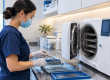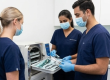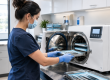
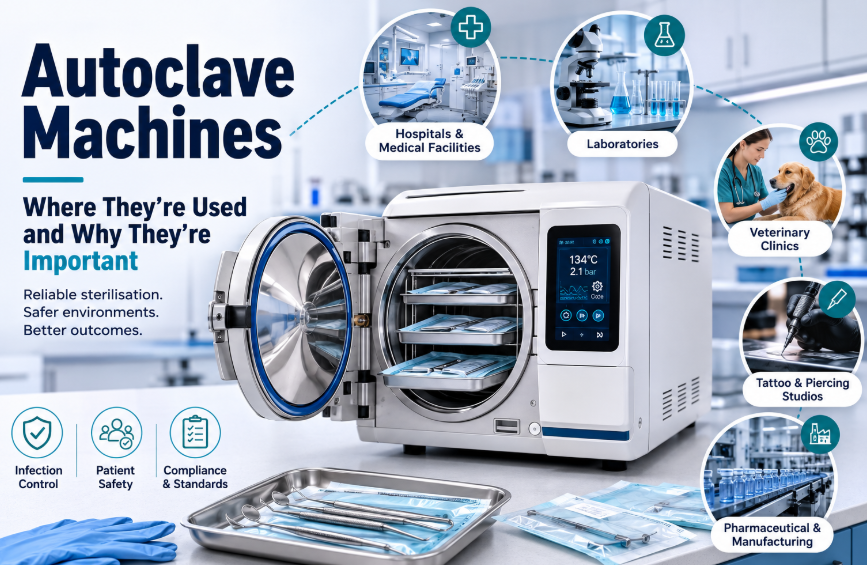
Autoclave machines play an essential role in infection control across healthcare, dental practices, laboratories, veterinary clinics, and other professional environments where instruments and equipment need to be properly sterilised.
By using high-temperature steam under pressure, an autoclave can destroy microorganisms that may remain on instruments after cleaning. This makes steam sterilisation an important part of safe instrument reprocessing.
But where are autoclaves commonly used, and why are they so important? Let’s take a closer look at the different industries and applications that rely on autoclave machines.
What Is an Autoclave Machine?
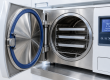
An autoclave machine is a sterilisation device that uses pressurised steam to treat equipment and materials that can withstand heat and moisture.
During a typical sterilisation cycle, the autoclave removes air from the chamber, introduces steam, and maintains a controlled temperature and pressure for a specified period. Once the sterilisation stage is complete, the load may go through a drying stage before the cycle finishes.
Autoclaves are available in different sizes and configurations, from compact benchtop units designed for dental practices to larger machines used in hospitals and laboratories.
The right autoclave depends on the type and volume of instruments being processed, as well as the specific requirements of the facility.
1. Dental Clinics
Dental practices are one of the most common environments where autoclave machines are used.
A dental autoclave is used to sterilise reusable dental instruments that come into contact with patients or potentially infectious material.
Common examples include:
- Dental mirrors
- Forceps
- Scalers
- Suitable dental handpieces
- Surgical instruments
- Other reusable dental equipment
Dental clinics often need quick and reliable instrument turnaround because the same types of instruments may be required throughout the day.
A suitable dental autoclave can help practices maintain an efficient workflow while supporting proper instrument reprocessing procedures.
2. Medical Clinics and Healthcare Facilities
Autoclaves are widely used in medical environments, including general practices, specialist clinics, treatment centres, and surgical facilities.
Depending on the facility and the type of equipment being processed, an autoclave may be used for:
- Surgical instruments
- Stainless-steel instruments
- Reusable medical equipment
- Certain glassware
- Heat- and moisture-resistant materials
Healthcare facilities often process different types of loads, making it important to select an autoclave with appropriate cycle capabilities and chamber capacity.
3. Laboratories
Lab autoclaves are commonly used in research, educational, pharmaceutical, microbiology, and other laboratory environments.
Laboratories may use autoclaves to sterilise suitable:
- Glassware
- Laboratory instruments
- Media and solutions
- Certain reusable equipment
- Laboratory waste before appropriate disposal
Laboratory applications can differ considerably from clinical sterilisation. Some facilities require larger chambers or specialised cycles depending on the materials being processed.
For this reason, selecting the right lab autoclave requires consideration of load type, volume, temperature requirements, and workflow.
4. Hospitals and Surgical Facilities
Hospitals can have significant sterilisation requirements because they may process large quantities of instruments every day.
Autoclaves may be used as part of a broader sterile processing workflow involving:
- Cleaning
- Inspection
- Packaging
- Sterilisation
- Drying
- Storage
- Distribution
Larger healthcare facilities may use high-capacity sterilisation equipment capable of handling substantial instrument loads.
Reliable equipment is particularly important in high-volume environments where unexpected downtime can affect daily operations.
5. Veterinary Clinics
Veterinary practices also rely on steam sterilisation for suitable reusable instruments.
Veterinary autoclave applications can include instruments used during:
- Surgical procedures
- Dental procedures
- General examinations
- Wound treatment
Because veterinary practices can have different instrument sizes and workloads, the ideal autoclave will depend on the clinic’s specific requirements.
6. Research and Scientific Facilities
Research facilities may use autoclaves for a wide range of sterilisation applications.
For example, laboratories conducting microbiological research may use autoclaves to process suitable laboratory materials, equipment, and waste.
In these environments, the autoclave can be an important part of laboratory safety and contamination-control procedures.
The machine must be operated according to the manufacturer’s instructions and the facility’s established procedures, particularly when processing specialised laboratory materials.
7. Pharmaceutical and Manufacturing Environments
Autoclaves can also be found in pharmaceutical, biotechnology, and manufacturing environments where controlled sterilisation processes are required.
Depending on the application, autoclaves may be used to process equipment, containers, components, or other heat-resistant materials.
These environments can have more specialised requirements than a typical clinic, so equipment selection, cycle development, documentation, and validation are particularly important.
8. Tattoo and Piercing Studios
Professional tattoo and piercing studios may use autoclaves to sterilise appropriate reusable instruments.
Where reusable equipment can penetrate the skin or come into contact with blood, proper cleaning and sterilisation procedures are critical.
A suitable benchtop autoclave can provide an efficient sterilisation solution for studios that use compatible reusable equipment.
Operators should always follow applicable regulations, manufacturer instructions, and established infection-control procedures.
Why Are Autoclave Machines Important?
The main purpose of an autoclave is to provide controlled steam sterilisation for items that are suitable for the process.
This is important because instruments that appear clean may still contain microorganisms that cannot be seen with the naked eye.
A properly operated and maintained autoclave helps facilities:
Reduce the Risk of Cross-Contamination
Proper sterilisation helps prevent microorganisms from being transferred between patients, procedures, or work environments.
Support Infection Control
Autoclaves form an important part of instrument reprocessing procedures in many healthcare and laboratory settings.
Protect Patients and Staff
Reliable sterilisation contributes to safer working environments and helps reduce the risks associated with contaminated reusable equipment.
Improve Workflow
Modern autoclave machines can offer automated cycles, efficient drying, cycle monitoring, and documentation features that help streamline daily operations.
Support Consistent Results
When the correct cycle is selected and the equipment is properly maintained, an autoclave can provide repeatable sterilisation conditions.
What Can Be Sterilised in an Autoclave?
Not everything can be placed inside an autoclave.
Suitable materials generally need to be capable of withstanding the temperature, moisture, and pressure associated with the selected cycle.
Depending on the equipment and manufacturer’s instructions, common autoclave loads can include:
- Stainless-steel instruments
- Certain glassware
- Heat-resistant laboratory equipment
- Suitable dental instruments
- Certain reusable medical instruments
Materials such as some plastics, electronics, oils, and heat-sensitive products may not be suitable for steam sterilisation.
Always check the manufacturer’s instructions for both the autoclave and the items being processed before running a cycle.
Choosing the Right Autoclave Machine
The best autoclave isn’t necessarily the largest or most expensive model. The right choice depends on how and where the machine will be used.
Consider factors such as:
- Load size: How many instruments need to be processed per cycle?
- Instrument type: Are you processing solid, hollow, porous, or wrapped loads?
- Cycle requirements: Which sterilisation cycles does your facility need?
- Available space: Will the machine be installed on a bench or as a larger standalone unit?
- Workflow: How quickly do instruments need to be available?
- Documentation: Do you require cycle records and traceability?
- Maintenance: Is local servicing and technical support available?
For practices with lower instrument volumes, a compact dental autoclave may be sufficient. Larger facilities may benefit from higher-capacity equipment designed for more demanding workloads.
Why Regular Autoclave Maintenance Matters
Buying a quality autoclave is only the beginning. Regular maintenance is essential for keeping the machine operating reliably.
Components such as door seals, filters, pumps, valves, sensors, and heating elements can experience wear over time.
Signs that your autoclave may require professional attention include:
- Steam leaking around the door
- Longer-than-usual cycles
- Inconsistent temperature or pressure
- Wet instruments after a cycle
- Unusual noises
- Repeated error messages
- Water leaks
- Frequent cycle failures
If you’ve noticed any of these problems, read our guide on Signs Your Autoclave Parts Need Repair or Replacement to learn more about common warning signs.
Regular servicing can also help identify problems before they result in unexpected equipment downtime.
Autoclave Machines and Sterilisation Validation
Maintenance and validation are two important aspects of keeping sterilisation equipment performing as expected.
Validation helps demonstrate that an autoclave is capable of consistently achieving the required sterilisation conditions for its intended use.
For facilities that require professional testing and validation, learn more about our Autoclave Validation Services.
New or Refurbished: Which Autoclave Is Right for You?
When purchasing an autoclave machine, facilities don’t necessarily have to choose between different new models.
Professionally refurbished autoclaves can be another option for practices looking for reliable equipment while managing their budget.
A properly refurbished machine should be thoroughly inspected, serviced, tested, and prepared for its intended application.
If you’re considering this option, explore our Refurbished Autoclaves to learn more about available solutions.
Choose the Right Autoclave With HTC Medical
Autoclave machines are used across a wide range of industries, from dental clinics and medical practices to laboratories, veterinary facilities, research environments, and pharmaceutical applications. While the exact requirements vary between industries, the goal remains the same: reliable and effective sterilisation of suitable reusable equipment and materials.
At HTC Medical, we help healthcare and professional facilities find, maintain, repair, and validate the right sterilisation equipment for their needs. We work with leading autoclave brands and provide services ranging from autoclave repairs and maintenance to validation and refurbished autoclave solutions.
If you’re looking for a dental autoclave, lab autoclave, or medical autoclave machine, contact HTC Medical to discuss your requirements and find a sterilisation solution that fits your facility.