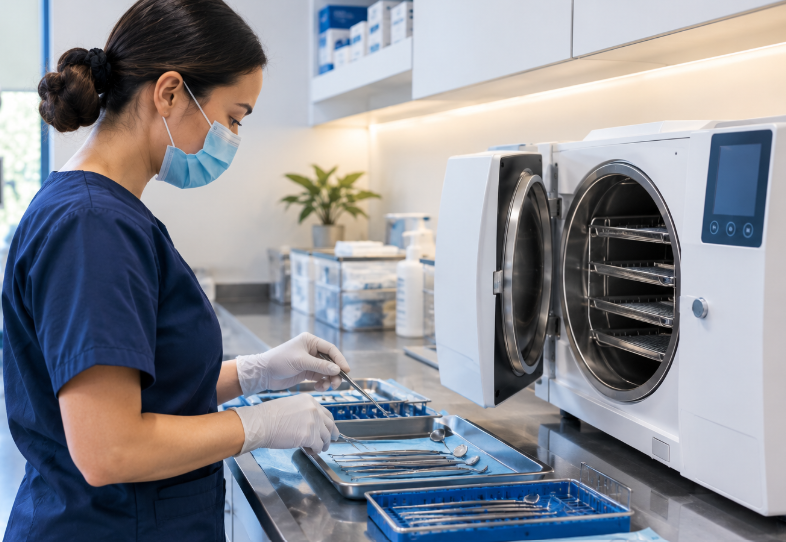
A dental clinic may need to run its autoclave several times throughout the day, but the exact number of cycles depends on patient volume, instrument usage, chamber capacity, and the clinic’s sterilisation workflow.
Some practices may manage their daily instrument requirements with a few well-planned loads, while busy multi-chair clinics may need to run their autoclaves much more frequently. The goal is to process instruments efficiently without overloading the machine or compromising sterilisation quality.
So, how many autoclave cycles does a dental clinic need each day? The answer comes down to how many instrument sets your practice uses, how many sets fit into each load, and how quickly those instruments need to be available again.
In this guide, HTC Medical explains how dental practices can estimate their daily autoclave requirements, plan sterilisation cycles, choose suitable equipment, and recognise when their current setup may need improvement.
How Many Times Should a Dental Clinic Run an Autoclave Each Day?
There is no single number of autoclave cycles that applies to every dental clinic. The required number depends on the clinic’s workload, the instruments used, the capacity of the steriliser, and the manufacturer’s approved cycle requirements.
A small dental practice with fewer treatment rooms may need fewer loads than a busy clinic with multiple dentists and hygienists working throughout the day.
The most practical approach is to calculate how many instrument sets your clinic needs and compare that number with the number of sets your autoclave can safely process per load.
For example, a clinic that uses 30 instrument sets daily and can process six suitable sets per load would need approximately five loads to process that volume, assuming each set is compatible with the selected cycle and the load configuration is permitted by the manufacturer.
This is a planning estimate, not a recommended number of cycles for every practice. Actual requirements will vary according to instrument types, packaging, load arrangement, cycle selection, and the need to reprocess instruments.
What Determines the Number of Daily Autoclave Cycles?
Several factors influence how frequently a dental practice needs to run its steriliser.
1. The Number of Patients Seen Each Day
Patient volume is one of the main factors affecting instrument processing requirements.
A clinic seeing a relatively small number of patients may have a manageable instrument workload, while a busy practice may need to process multiple sets between appointments.
However, patient numbers alone do not determine the required number of cycles. Different procedures use different combinations of instruments, and some instruments may need to be processed more frequently than others.
To estimate your workload, consider:
- The average number of patients treated daily
- The types of dental procedures performed
- The number of instrument sets used per appointment
- The number of treatment rooms operating simultaneously
- The availability of additional instrument sets
Keeping a record of actual instrument usage over a typical working week can help your team estimate daily sterilisation demand more accurately.
2. The Capacity of Your Dental Autoclave
Autoclave chamber capacity affects how many instrument sets can be processed in one load.
A smaller benchtop autoclave may suit a practice with a lower instrument volume. A larger-capacity model may be more appropriate for a busy dental clinic that needs to process several sets at once.
However, chamber size alone does not determine the number of instruments you can sterilise in a single cycle.
The size and shape of the instruments, packaging, tray configuration, load arrangement, and manufacturer’s instructions all affect the permitted load.
Overloading an autoclave to reduce the number of daily cycles can interfere with air removal, steam penetration, and drying. Always follow the manufacturer’s instructions for loading the steriliser.
If you are reviewing your current equipment, read HTC Medical’s guide to dental autoclaves and choosing the right steriliser for your practice.
3. The Type of Dental Instruments Being Sterilised
Not all dental instruments have the same processing requirements.
Dental handpieces, hollow instruments, solid instruments, packaged instrument sets, and other reusable devices may require different approved cycles or loading arrangements.
Your team should identify the instruments that need to be processed and check the manufacturer’s instructions for both the instruments and the autoclave.
Some loads may require specific air-removal and drying capabilities. As a result, the number of cycles needed each day may be affected by the types of instruments your clinic uses, rather than just the number of patients treated.
Using an appropriate sterilisation cycle is more important than trying to reduce cycle numbers.
4. Autoclave Cycle Duration
The total time required for a sterilisation cycle also affects daily scheduling.
A complete cycle may include air removal, steam exposure, pressure and temperature control, and drying. The duration varies according to the autoclave model, cycle selected, load type, and other operating conditions.
For more information, read HTC Medical’s guide to how long autoclave sterilisation takes.
A clinic that needs instruments available throughout the day should consider the complete cycle time, including drying, when planning its workflow.
It is not advisable to select a faster cycle simply to increase daily throughput. The cycle must be suitable for the load and used according to the manufacturer’s instructions.
5. The Number of Instrument Sets Available
Having enough instrument sets available can help a dental practice manage its sterilisation workload.
If a clinic has only a limited number of sets, staff may need to wait for instruments to complete the cleaning, sterilisation, and drying process before they can be used again.
Additional instrument sets can provide more flexibility, particularly during busy periods. However, they do not eliminate the need for appropriate cleaning, inspection, sterilisation, and storage.
Clinics should review their instrument inventory alongside their daily patient schedule to identify potential bottlenecks.
How to Calculate the Number of Autoclave Cycles Your Clinic Needs
A simple calculation can help estimate your daily sterilisation workload.
Daily autoclave cycles = Total instrument sets requiring processing ÷ Suitable sets per load
Round the result up to the next whole number, because you cannot run a fraction of a cycle.
For example, consider a dental practice that uses 36 instrument sets per day and can safely process six sets per load.
- Daily instrument sets: 36
- Suitable instrument sets per load: 6
- Estimated cycles: 36 ÷ 6 = 6 cycles
In this example, the clinic would need six loads to process 36 instrument sets, provided the loading arrangement and selected cycle are appropriate for those instruments.
If some instrument sets cannot be processed together, or different loads require different cycles, the clinic may need additional cycles.
This calculation is useful for planning, but the final number should be based on the practice’s actual workflow and equipment requirements.
A Simple Daily Planning Example
The following examples illustrate how workload and suitable load capacity can affect the number of cycles.
| Instrument sets per day | Sets per suitable load | Estimated cycles |
|---|---|---|
| 12 | 4 | 3 |
| 24 | 6 | 4 |
| 36 | 6 | 6 |
| 48 | 8 | 6 |
| 60 | 6 | 10 |
These figures are hypothetical examples, not standard cycle recommendations. They assume that all sets can be processed in the stated load size and that each load uses an appropriate cycle.
Your clinic may require more cycles depending on instrument compatibility, load separation, packaging, and workflow requirements.
Should a Dental Clinic Run Its Autoclave Continuously Throughout the Day?
Not necessarily. The appropriate schedule depends on when instruments are needed and how many suitable sets are available.
Some clinics may benefit from planned batches of instrument processing, while others need to run cycles more frequently to support appointments throughout the day.
The important consideration is whether the sterilisation workflow can supply the required instruments without creating unnecessary delays.
A practical daily schedule should account for:
- Expected patient appointments
- Instrument availability
- Cleaning and preparation time
- Complete sterilisation cycle and drying time
- Required monitoring and record keeping
- Time for handling and storing processed instruments
- Contingency arrangements if a cycle fails
Clinics should not rush instrument preparation or interrupt required stages simply to meet appointment schedules.
If a sterilisation cycle fails, the load must be managed according to the clinic’s documented procedures and the manufacturer’s instructions. Instruments should not be treated as sterile simply because the machine has finished running.
Signs Your Dental Clinic May Need a Larger Autoclave
If your steriliser is constantly running and your team still struggles to keep up with instrument demand, it may be worth reviewing the capacity of your current equipment.
Frequent cycles are not automatically a problem. They may be entirely appropriate for a clinic’s workload. However, persistent delays can indicate that the sterilisation setup needs improvement.
Consider reviewing your equipment if:
- Staff regularly wait for instruments between appointments.
- The autoclave operates near capacity throughout the day.
- Your clinic has added more treatment rooms or practitioners.
- Instrument demand has increased significantly.
- The current machine cannot accommodate your required load types.
- Drying time creates recurring delays in instrument availability.
- A machine breakdown would leave the clinic without sufficient sterilisation capacity.
Possible solutions include improving instrument inventory, adjusting the workflow, reviewing load capacity, or purchasing an additional or larger autoclave.
Before replacing your machine, assess the actual instrument workload and the requirements of the instruments being processed.
HTC Medical supplies new and refurbished autoclaves for healthcare facilities. Explore autoclaves for sale to review available equipment options.
How Regular Autoclave Servicing Helps Busy Dental Practices
A dental clinic that relies on its autoclave throughout the day needs equipment that performs consistently.
Routine servicing helps identify wear and potential faults before they cause unexpected disruption. Depending on the machine, maintenance may involve inspecting door seals, filters, valves, pumps, sensors, and other components.
Clinics should follow the manufacturer’s maintenance schedule and consider the equipment’s workload when planning professional servicing.
Warning signs that deserve attention include:
- Repeated cycle failures
- Unusual changes in cycle duration
- Water leaks or pressure problems
- Poor drying performance
- Error messages or unexpected alarms
- Unusual noises during operation
If you notice these issues, investigate them according to the manufacturer’s instructions and arrange professional assistance when needed.
HTC Medical provides autoclave repair and maintenance services across NSW to support medical and dental facilities.
Does Running More Autoclave Cycles Mean Your Clinic Needs Validation?
The number of cycles your clinic runs each day is not, by itself, a reason to assume that validation is required more frequently.
Validation and routine servicing serve different purposes. Servicing focuses on maintaining the equipment, while validation and other required performance checks help establish that the sterilisation equipment and process perform as intended.
Dental practices should follow the applicable Australian requirements, manufacturer instructions, and their documented infection prevention and control procedures.
Changes to equipment, major repairs, relocation, or changes to the sterilisation process may affect testing or validation requirements. A qualified service provider can help determine what is appropriate for your equipment and circumstances.
For more information, see HTC Medical’s autoclave validation services.
How to Improve Autoclave Efficiency in a Dental Clinic
Reducing unnecessary delays does not mean compromising sterilisation quality. The aim is to make better use of the equipment and instrument inventory you already have.
Plan Instrument Processing Around Your Workload
Review your appointment schedule and identify periods when instrument demand is likely to be highest.
Planning ahead can help your team prepare sufficient instrument sets and avoid preventable delays.
Use the Correct Load Configuration
Follow the manufacturer’s loading instructions and avoid overloading the chamber.
Suitable load arrangements help support effective air removal, steam penetration, and drying.
Maintain an Adequate Instrument Inventory
Having enough reusable instrument sets available can reduce pressure to make instruments available before the complete reprocessing process has finished.
The appropriate inventory depends on your clinic’s procedures, patient volume, and sterilisation turnaround time.
Monitor Cycle Records
Keep the required cycle records and review them according to your practice procedures.
Records can help identify recurring problems, unusual cycle durations, failed cycles, and opportunities to improve workflow.
Keep Up With Preventive Maintenance
Regular maintenance can help reduce avoidable equipment interruptions.
If your machine frequently takes longer than expected or experiences repeated failures, do not assume that the issue is simply caused by a busy workload. Professional assessment may be needed.
Frequently Asked Questions
How many autoclave cycles does a small dental clinic need per day?
There is no fixed number. A small clinic’s daily requirement depends on patient volume, the number of instrument sets used, the autoclave’s suitable load capacity, and the types of instruments being processed.
Calculate the number of sets that require sterilisation and divide this by the number that can be safely processed in each suitable load.
How many autoclave cycles can a dental autoclave run in one day?
The number depends on the specific machine, its approved operating conditions, the complete cycle duration, the manufacturer’s recommendations, and the clinic’s workload.
Check the manufacturer’s instructions rather than assuming that a machine can safely operate continuously or handle a particular number of cycles each day.
Can a dental clinic sterilise all its instruments in one autoclave cycle?
Only if the complete load is compatible with the selected cycle and fits within the manufacturer’s permitted loading configuration.
The required number of cycles depends on the quantity and types of instruments, packaging, load arrangement, and processing requirements.
Is it better to run several small loads or fewer large loads?
Neither approach is automatically better. The best approach is to use suitable load sizes that comply with the manufacturer’s instructions and support the clinic’s workflow.
Larger loads may improve throughput when the machine permits them, but overloading or combining incompatible items can compromise the sterilisation process.
Does a busy dental clinic need a larger autoclave?
Not always. A larger autoclave may help if the existing chamber cannot meet the clinic’s instrument-processing needs. However, additional instrument sets, improved scheduling, or a different workflow may also help.
Review actual demand, cycle times, load requirements, and future clinic growth before purchasing new equipment.
How often should a dental autoclave be serviced?
The appropriate interval depends on the autoclave model, manufacturer’s recommendations, workload, and applicable requirements. Busy clinics should pay particular attention to maintenance schedules because unexpected downtime can disrupt daily operations.
Read HTC Medical’s guide to how often an autoclave should be serviced.
Does an autoclave need validation even if it runs several successful cycles each day?
Successful cycle completion does not replace required validation, performance testing, monitoring, or documentation. Clinics should follow applicable requirements and the manufacturer’s instructions to establish that their sterilisation equipment and processes are performing as intended.
Final Thoughts
So, how many autoclave cycles does a dental clinic need each day?
The answer depends on the number of instrument sets used, the capacity of the autoclave, the type of instruments being processed, and the clinic’s daily schedule. Rather than following a fixed number, calculate your workload and plan around suitable loads and complete cycle times.
If your clinic is experiencing frequent delays, repeated cycle failures, or difficulty keeping instruments available, it may be time to review your sterilisation workflow and equipment capacity.
HTC Medical supports dental and medical facilities across Sydney and NSW with autoclave sales, repair, maintenance, and validation services. Whether you need help maintaining an existing steriliser or are considering a new or refurbished machine, our team can help you assess your requirements.
Contact HTC Medical to discuss your autoclave servicing, validation, or equipment needs.