If you use an autoclave in a dental practice, medical clinic, veterinary facility, laboratory, or other healthcare setting, you may wonder: how long does autoclave sterilisation take?
In general, an autoclave cycle can take anywhere from around 30 minutes to more than an hour, depending on the autoclave model, sterilisation cycle, load size, instrument type, temperature, and drying requirements. Some fast cycles can be shorter, while larger or more complex loads can take considerably longer.
It is important to remember that the sterilisation stage is only one part of the complete autoclave cycle. The machine also needs time to heat the chamber, remove air where required, expose the load to saturated steam, depressurise, and dry the instruments.
What Is an Autoclave Sterilisation Cycle?
An autoclave sterilisation cycle uses high-temperature steam under pressure to destroy microorganisms on compatible instruments and equipment.
Although the exact process varies between machines, a typical cycle can include several stages:
- Air removal
- Chamber heating
- Steam exposure
- Sterilisation or holding phase
- Depressurisation
- Drying
- Cycle completion
The sterilisation stage itself may only take several minutes, but the complete process takes longer because the machine must prepare the load and safely complete the cycle.
This is why the answer to “how long does an autoclave take?” cannot be based on the sterilisation holding time alone.
How Long Does a Typical Autoclave Cycle Take?
A typical autoclave cycle may take approximately 30 to 60 minutes, although this is only a general guide.
The actual cycle time depends heavily on the type of cycle being used.
For example, a cycle for simple solid, unwrapped instruments may be relatively quick, while a cycle designed for wrapped, hollow, or porous loads may require additional air removal, steam penetration, and drying time.
The manufacturer’s instructions should always be followed because different autoclave models use different cycle parameters.
What Factors Affect Autoclave Sterilisation Time?
Several factors can change how long an autoclave cycle takes.
1. Type of Autoclave
Different autoclaves are designed for different applications and load types.
For example, Class B autoclaves use vacuum technology to help remove air and allow steam to penetrate suitable wrapped, hollow, and porous loads. These cycles can take longer than simpler cycles designed for basic solid instruments.
If you are comparing autoclave types, our guide to Class B, S and N autoclaves explains the main differences and applications.
2. Type of Instruments
The instruments being sterilised have a major effect on cycle selection and duration.
Solid instruments may require a different cycle from:
- Wrapped instruments
- Hollow instruments
- Porous materials
- Dental handpieces
- Surgical instruments
- Other compatible medical devices
The correct cycle should always be selected according to the autoclave manufacturer’s instructions and the requirements of the items being processed.
3. Load Size
A heavily loaded chamber can take longer to heat and dry than a smaller load.
However, loading an autoclave beyond the manufacturer’s recommended capacity is not a way to save time. Overloading can interfere with steam circulation and may prevent effective sterilisation and drying.
The goal should be to load the chamber correctly rather than simply fitting as many instruments as possible into each cycle.
4. Sterilisation Temperature
Temperature is another important factor.
Common steam sterilisation temperatures include 121°C and 134°C, depending on the equipment, load, and selected cycle.
The temperature and exposure time must work together to achieve the required sterilisation conditions. A higher temperature does not automatically mean that every load will be sterilised faster.
The correct cycle parameters should always come from the autoclave manufacturer and applicable sterilisation requirements.
5. Drying Time
Drying can add significant time to the overall cycle.
After sterilisation, instruments and packaging may need to be dried before the cycle is complete. This is particularly important for wrapped instruments because moisture can compromise packaging and handling after the cycle.
If your autoclave is taking unusually long to complete its drying stage, the cause may be related to the load, water quality, loading method, equipment settings, or a component that requires attention.
6. Autoclave Model and Technology
Modern autoclaves can have different cycle designs, vacuum systems, heating systems, and drying technologies.
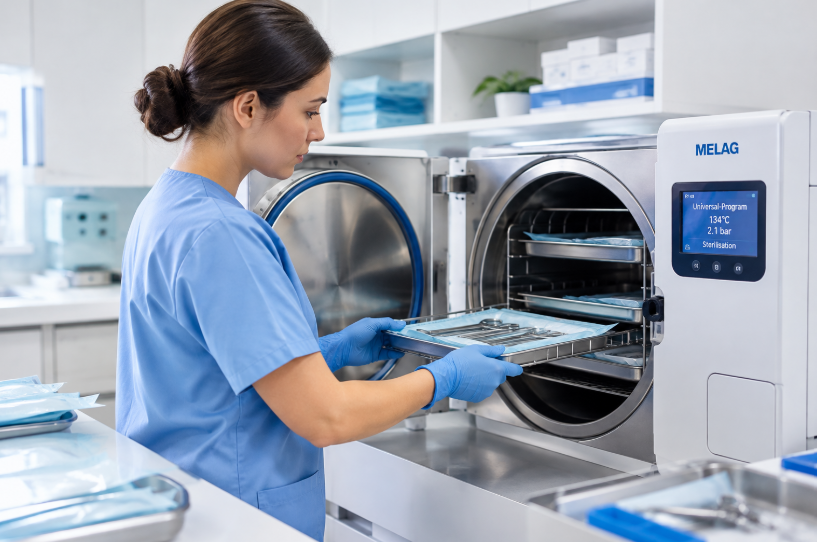
For example, some MELAG and Mocom machines are designed with specific cycle options to accommodate different clinical applications.
The advertised cycle time of an autoclave should therefore not be treated as a universal sterilisation time. Always check the manufacturer’s specifications for the exact model.
How Long Does a 134°C Autoclave Cycle Take?
A 134°C cycle can have a relatively short sterilisation holding period, but the complete cycle will take longer because heating, air removal, steam exposure, pressure release, and drying are also involved.
The exact duration depends on the machine and cycle selected.
For this reason, it is better to think about autoclave cycle time as the entire process from cycle start to cycle completion, rather than just the number of minutes spent at 134°C.
How Long Does a 121°C Autoclave Cycle Take?
A 121°C cycle generally uses a longer exposure period than a comparable higher-temperature cycle.
However, the total cycle time will still depend on the machine, load, packaging, and drying requirements.
For healthcare practices, the correct temperature and exposure time should be selected based on the manufacturer’s validated cycle parameters rather than choosing a cycle simply because it appears faster.
Why Does My Autoclave Take So Long?
If your autoclave suddenly takes much longer than usual, it may indicate an issue that needs to be investigated.
Possible causes can include:
- Incorrect loading
- Excessive load size
- Problems with water quality
- A worn door seal
- Vacuum system problems
- Heating system issues
- Sensor problems
- Drainage problems
- Reduced drying performance
- Maintenance requirements
A longer cycle is not necessarily a fault. Different loads and cycle types naturally have different durations.
However, a significant change from the machine’s normal performance should not be ignored.
Regular servicing and preventive maintenance can help identify problems before they affect the reliability of the sterilisation process.
If you are experiencing cycle problems, you can learn more about autoclave repair and maintenance services available from HTC Medical.
Does a Faster Autoclave Cycle Mean Better Performance?
Not necessarily.
Cycle speed is only one factor to consider when evaluating an autoclave. The cycle must be appropriate for the load and achieve the required sterilisation conditions.
A fast cycle that is not suitable for the instruments being processed is not a replacement for the correct sterilisation cycle.
For busy dental and medical practices, it is more useful to consider:
- Cycle suitability
- Load capacity
- Steam penetration
- Drying performance
- Reliability
- Validation
- Maintenance requirements
- Manufacturer support
Choosing the correct autoclave for your workload can help improve efficiency without compromising the sterilisation process.
If you’re looking for an autoclave for your practice, see our range of new and refurbished autoclaves for sale.
How Can You Reduce Autoclave Cycle Times?
You should never shorten a validated sterilisation cycle simply to process instruments faster.
Instead, focus on improving the way the autoclave is used.
Load the Autoclave Correctly
Avoid overloading the chamber and make sure instruments are positioned according to the manufacturer’s instructions.
Select the Correct Cycle
Choose the cycle that matches the type of instruments and packaging being processed.
Maintain the Equipment
Regular maintenance can help keep heating, vacuum, sealing, and drying systems operating correctly.
Use Appropriate Water
Water quality can affect autoclave performance and the condition of internal components. Follow the manufacturer’s requirements for the appropriate water quality.
Keep Instruments Properly Prepared
Cleaning and preparing instruments correctly before sterilisation is an important part of the overall reprocessing process.
How Does Autoclave Validation Relate to Cycle Time?
A cycle completing successfully does not, by itself, prove that the sterilisation process is performing correctly.
Autoclave validation involves verifying that the equipment and sterilisation process are achieving the required performance under defined conditions.
Validation can include checking factors such as temperature, pressure, steam penetration, and cycle performance.
This is particularly important for healthcare facilities that rely on sterilisation equipment as part of their infection-control processes.
For more information, see HTC Medical’s autoclave validation services.
How Long Should You Wait Before Using Instruments After Sterilisation?
Instruments should not simply be removed and used immediately when the sterilisation phase finishes.
The complete cycle should finish, including the drying stage where applicable. Instruments should then be handled and stored according to the manufacturer’s instructions and your facility’s infection-control procedures.
For wrapped instruments, proper drying is particularly important because compromised or wet packaging can affect the protection provided by the sterile barrier.
Frequently Asked Questions
How long does autoclave sterilisation take?
A complete autoclave cycle commonly takes around 30 to 60 minutes, but some cycles may be shorter or longer. The exact time depends on the autoclave model, cycle type, load, temperature, and drying requirements.
How long does a 134°C autoclave cycle take?
The sterilisation holding period at 134°C may be relatively short, but the complete cycle takes longer because the machine must heat, remove air where required, sterilise, depressurise, and dry the load.
How long does a 121°C autoclave cycle take?
A 121°C cycle generally requires a longer exposure period than a higher-temperature cycle. The total cycle time depends on the autoclave, load, and selected program.
Why does my autoclave take longer than normal?
A longer-than-normal cycle can be caused by the type or size of the load, drying requirements, water quality, or equipment issues involving components such as seals, sensors, heating systems, or vacuum systems.
Can I shorten an autoclave cycle?
You should not manually shorten a validated sterilisation cycle. Always use the appropriate cycle specified by the manufacturer for the load being processed.
Does a bigger autoclave take longer?
Not necessarily. Cycle time depends on the machine’s design and the selected program. However, larger or heavier loads can require more time for heating and drying.
Choosing an Autoclave for Your Practice
If sterilisation turnaround time is important to your practice, don’t look at cycle speed alone.
Consider the types of instruments you process, your daily workload, the required cycle types, chamber capacity, drying performance, servicing requirements, and the manufacturer’s specifications.
A dental practice with a high volume of instruments may have different requirements from a small medical clinic, veterinary practice, or laboratory.
HTC Medical supplies and supports autoclaves for healthcare facilities across NSW, including new and professionally refurbished machines from established brands such as MELAG, Mocom, Hatmed and Aura.
Our refurbished autoclaves are inspected, tested, and validated before sale, providing practices with another option when purchasing sterilisation equipment.
Final Thoughts
So, how long does autoclave sterilisation take?
For many machines, a complete cycle can take around 30 to 60 minutes, but there is no single cycle time that applies to every autoclave or every load.
The actual duration depends on the autoclave, sterilisation cycle, temperature, instruments, load size, packaging, air removal requirements, and drying process.
The most important consideration is not simply how quickly the cycle finishes. The cycle must be appropriate for the load and operate according to the manufacturer’s specified parameters.
If your autoclave is taking significantly longer than normal, repeatedly failing cycles, or experiencing drying or vacuum problems, professional servicing and testing can help identify the cause.
HTC Medical provides autoclave sales, servicing, repair, maintenance, and validation across NSW. If you need help with an existing steriliser or are looking for a new or refurbished autoclave, contact HTC Medical to discuss your requirements.