Buying a refurbished autoclave is an excellent way to access reliable sterilisation equipment without the higher cost of purchasing a brand-new unit. For many dental practices, medical clinics, veterinary hospitals, laboratories, and healthcare facilities, a professionally refurbished autoclave offers the ideal balance of performance, quality, and value.
However, not all refurbished autoclaves are restored to the same standard. The quality of the refurbishment process and the testing carried out before the equipment is sold are what separate a dependable machine from one that may cause costly downtime later.
So, how are refurbished autoclaves tested before they’re ready for sale? Here’s what a thorough refurbishment and testing process should include.
What Is a Refurbished Autoclave?
A refurbished autoclave is a previously owned steam steriliser that has been professionally inspected, repaired where necessary, cleaned, tested, and restored to ensure it performs safely and reliably.
Unlike a used autoclave sold “as is”, a professionally refurbished unit undergoes a comprehensive evaluation to verify that it meets operational and safety requirements before being supplied to a new owner.
When purchased from a reputable supplier, refurbished autoclaves can provide years of dependable service while offering significant cost savings.
Why Testing Matters
An autoclave plays a vital role in infection prevention by sterilising reusable medical and dental instruments.
If the steriliser fails to reach the correct temperature, pressure, or exposure time, instruments may not be fully sterilised.
That’s why every refurbished autoclave should undergo rigorous testing before it’s made available for sale.
Comprehensive testing helps:
- Verify sterilisation performance
- Confirm equipment safety
- Detect hidden mechanical faults
- Improve long-term reliability
- Reduce the risk of unexpected breakdowns
- Support compliance with Australian healthcare requirements
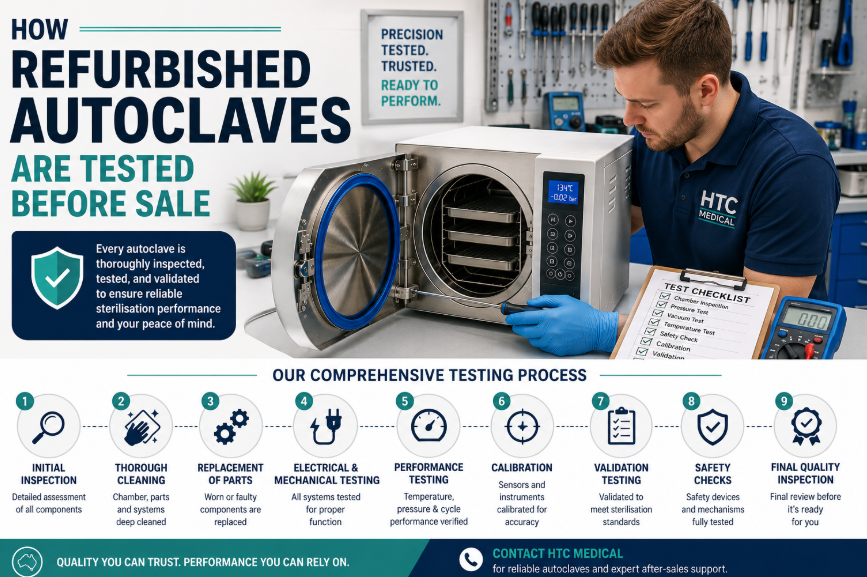
Step 1: Initial Inspection
The refurbishment process begins with a detailed inspection of the entire unit.
Technicians assess the condition of:
- The sterilisation chamber
- Door assembly
- Seals and gaskets
- Steam generator
- Heating elements
- Valves and pipework
- Electrical components
- Control panel
- Sensors
- Water system
Any worn, damaged, or defective components are identified before refurbishment begins.
Step 2: Thorough Cleaning
Before any performance testing takes place, the autoclave is carefully cleaned.
Over time, mineral deposits, scale, residue, and debris can affect sterilisation efficiency.
Cleaning may include:
- Chamber cleaning
- Pipe flushing
- Filter cleaning
- Scale removal
- Water reservoir cleaning
- Exterior restoration
A clean steriliser provides a better starting point for accurate testing and reliable operation.
Step 3: Replacement of Worn Components
Refurbishment often involves replacing parts that naturally wear during normal operation.
Common replacement components include:
- Door seals
- Safety valves
- Filters
- O-rings
- Pressure fittings
- Temperature sensors
- Water filters
- Vacuum components where required
Replacing ageing parts helps restore performance and reduce future maintenance issues.
Step 4: Electrical and Mechanical Testing
Every refurbished autoclave should undergo detailed mechanical and electrical inspections.
Technicians verify that all major systems operate correctly, including:
- Heating systems
- Steam generation
- Pressure control
- Vacuum systems
- Door locking mechanisms
- Safety devices
- Electrical circuits
- Display panels
- Control software
Any faults discovered during testing are repaired before the unit progresses to the next stage.
Step 5: Performance Testing
Once repairs are complete, the autoclave is tested under normal operating conditions.
Performance testing confirms that the steriliser consistently achieves:
- Correct chamber temperature
- Stable operating pressure
- Required sterilisation holding times
- Effective steam penetration
- Proper drying performance
Multiple test cycles are often completed to ensure reliable and repeatable performance.
Step 6: Calibration
Calibration is essential for ensuring accurate readings throughout every sterilisation cycle.
Technicians verify the accuracy of:
- Temperature sensors
- Pressure gauges
- Control systems
- Timing functions
Proper calibration helps ensure the displayed values accurately reflect actual operating conditions.
Step 7: Validation Testing
Professional suppliers often perform autoclave validation before supplying refurbished equipment.
Validation verifies that the steriliser consistently performs according to recognised sterilisation requirements.
Validation may include:
- Temperature mapping
- Pressure verification
- Leak testing
- Vacuum testing
- Steam quality assessment
- Performance qualification
Validation provides additional confidence that the equipment is operating correctly before installation.
Step 8: Safety Checks
Patient and operator safety always comes first.
Before sale, safety systems should be tested to ensure they operate correctly.
These checks may include:
- Door interlock testing
- Pressure relief valve testing
- Over-temperature protection
- Emergency shutdown functions
- Electrical safety inspections
Safety testing helps minimise operational risks once the autoclave is installed.
Step 9: Final Quality Inspection
Before leaving the workshop, the refurbished autoclave undergoes one final inspection.
Technicians confirm that:
- All repairs have been completed
- Test results meet required standards
- The unit is clean and presentable
- Accessories are included
- Documentation is complete
Only after passing final quality checks is the autoclave prepared for delivery.
What Should You Ask Before Buying a Refurbished Autoclave?
Not all suppliers follow the same refurbishment process.
Before purchasing, ask questions such as:
- Has the autoclave been fully tested?
- Were worn parts replaced?
- Has calibration been completed?
- Has validation been performed?
- Is servicing history available?
- Does the supplier provide ongoing maintenance?
- Are repair services available?
- Is technical support included?
These questions can help you make a more informed purchasing decision.
Why Buy from a Trusted Supplier?
A reputable supplier offers more than just equipment.
They provide ongoing support throughout the life of your sterilisation equipment, including:
- Professional installation
- Autoclave validation
- Preventative maintenance
- Routine servicing
- Calibration
- Technical support
- Autoclave repair
- Genuine replacement parts
Having access to these services helps maximise equipment reliability and minimise downtime.
Invest with Confidence
A professionally refurbished autoclave can be a smart investment for healthcare facilities looking to reduce costs without compromising on quality or performance.
The key is choosing equipment that has been thoroughly inspected, repaired, calibrated, validated, and tested before sale.
At HTC Medical, we supply high-quality new and refurbished autoclaves that undergo comprehensive testing to ensure dependable sterilisation performance. We also provide professional installation, autoclave validation, preventative maintenance, servicing, calibration, and repair services for healthcare facilities across Australia.
If you’re looking for reliable refurbished autoclaves backed by expert support, contact HTC Medical today. Our team can help you choose the right sterilisation solution for your practice or facility.