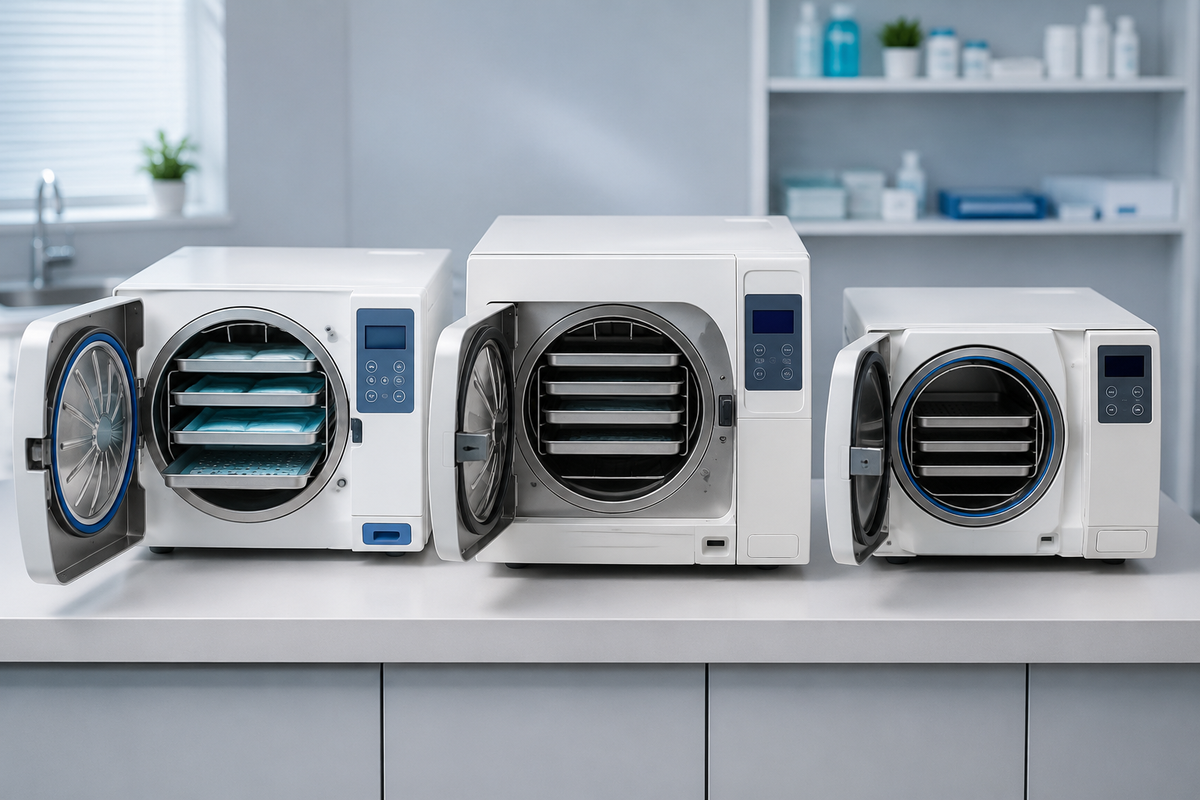
Choosing the right autoclave machine isn’t always straightforward. With terms like B-Class, S-Class, and N-Class appearing on product specifications, many healthcare professionals find themselves wondering what these classifications actually mean and which one is best suited to their practice.
The reality is that not all autoclaves offer the same sterilization capabilities. While every autoclave is designed to use high-pressure steam sterilization to eliminate bacteria, viruses, fungi, and other harmful microorganisms, the way they achieve sterilization can vary significantly.
Understanding the differences between B-Class, S-Class, and N-Class autoclaves is essential for maintaining effective infection control, complying with industry standards, and ensuring that medical instruments are properly sterilized between uses.
Whether you’re running a dental clinic, medical centre, veterinary practice, podiatry clinic, laboratory, or cosmetic treatment facility, selecting the right sterilization equipment can improve workflow efficiency, protect patients, and reduce the risk of cross-contamination.
Why Autoclave Classification Matters
When people compare autoclaves, they often focus on chamber size, cycle times, or price. While these factors are important, the classification of the autoclave is arguably even more critical.
Different instruments require different sterilization methods. A simple stainless steel instrument may be relatively easy to sterilize, while hollow instruments, wrapped surgical kits, dental handpieces, and porous materials require more advanced steam penetration.
If an autoclave cannot effectively remove air from the chamber and from within the instruments themselves, steam may not reach every surface. This can compromise sterilization effectiveness and potentially create infection control risks.
That’s why international sterilization standards distinguish between different classes of autoclaves based on their performance and intended applications.
Understanding How Steam Sterilization Works
Before comparing autoclave classes, it helps to understand the basics of steam sterilization.
An autoclave works by generating saturated steam under pressure. The combination of heat, moisture, and pressure destroys microorganisms and their spores, making instruments safe for reuse.
For sterilization to be effective, steam must come into direct contact with all instrument surfaces. Air trapped inside instruments, packaging, or the sterilization chamber can prevent this contact from occurring.
The primary difference between B-Class, S-Class, and N-Class autoclaves is how they manage air removal and steam penetration throughout the sterilization cycle.
B-Class Autoclaves: The Highest Standard of Sterilization
B-Class autoclaves are widely regarded as the most advanced and versatile medical sterilizers available.
They use a pre-vacuum and post-vacuum process that actively removes air from the chamber before steam is introduced. This vacuum technology allows steam to penetrate complex loads far more effectively than other autoclave types.
Because air is removed from difficult-to-reach areas, B-Class autoclaves can sterilize:
- Wrapped instruments
- Unwrapped instruments
- Hollow instruments
- Dental handpieces
- Surgical instruments
- Porous materials
- Complex instrument sets
- Packaged loads
This versatility makes B-Class units the preferred choice in healthcare environments where a wide variety of instruments are processed daily.
Benefits of B-Class Autoclaves
One of the biggest advantages of a B-Class autoclave is flexibility. Staff do not need to spend time sorting instruments based on sterilization limitations because the machine is capable of handling virtually all load types.
Additional benefits include:
- Superior steam penetration
- Advanced vacuum technology
- Faster drying cycles
- Enhanced infection control
- Greater compliance with healthcare regulations
- Suitable for packaged instrument storage
- Reliable sterilization validation
Many healthcare professionals view a B-Class autoclave as a long-term investment because it can accommodate future growth and changing sterilization requirements.
Where B-Class Autoclaves Are Commonly Used
B-Class autoclaves are frequently installed in:
- Dental practices
- Day surgery centres
- Medical clinics
- Veterinary hospitals
- Specialist healthcare facilities
- Podiatry clinics
- Universities and research laboratories
For practices performing surgical procedures or processing critical instruments, B-Class sterilization is often considered the benchmark.
S-Class Autoclaves: A Practical Middle Ground
S-Class autoclaves sit between B-Class and N-Class models in terms of performance and capability.
Unlike B-Class units, there is no single universal definition that applies to all S-Class autoclaves. The sterilization capabilities of an S-Class machine depend largely on the manufacturer’s specifications and validation testing.
This means some S-Class autoclaves may be capable of sterilizing certain wrapped instruments and hollow devices, while others may have more restrictions.
Because of these differences, it’s important to carefully review the manufacturer’s guidelines before purchasing an S-Class sterilizer.
Benefits of S-Class Autoclaves
For many practices, S-Class autoclaves provide an attractive balance between capability and affordability.
Benefits often include:
- Greater versatility than N-Class units
- More affordable than many B-Class models
- Suitable for a wider range of instruments
- Efficient sterilization cycles
- Compact benchtop designs
- Lower operating costs
Many clinics choose S-Class autoclaves when their sterilization requirements are moderate but still extend beyond simple solid instruments.
Typical Applications for S-Class Autoclaves
Depending on the model, S-Class autoclaves may be suitable for:
- Dental clinics
- Veterinary clinics
- Cosmetic practices
- Medical consulting rooms
- Podiatry clinics
- Allied health facilities
However, understanding the specific capabilities of the machine is essential before making a purchasing decision.
N-Class Autoclaves: Designed for Basic Sterilization Tasks
N-Class autoclaves are the most basic type of steam sterilizer.
Rather than using vacuum technology, they rely on gravity displacement to remove air from the chamber. As steam enters, it pushes air downward and out of the chamber.
While this approach is effective for simple loads, it has limitations when dealing with more complex instruments.
Generally, N-Class autoclaves are designed to sterilize:
- Solid instruments
- Unwrapped instruments
- Simple metal tools
They are typically not intended for:
- Wrapped instruments
- Hollow instruments
- Porous materials
- Dental handpieces
- Complex surgical equipment
Advantages of N-Class Autoclaves
Despite their limitations, N-Class autoclaves remain popular in certain environments.
Key advantages include:
- Lower upfront investment
- Simple operation
- Compact footprint
- Reduced maintenance requirements
- Cost-effective sterilization solution
For facilities with straightforward sterilization needs, an N-Class autoclave can still provide reliable performance.
Limitations to Consider
Before purchasing an N-Class unit, it’s important to evaluate future requirements.
Many practices eventually expand their services, purchase more advanced instruments, or face stricter infection control requirements. In these situations, an N-Class autoclave may become restrictive and require replacement sooner than expected.
Factors to Consider Before Buying an Autoclave
Selecting the right autoclave involves more than choosing a class.
Healthcare professionals should also consider:
Instrument Types
What instruments are being sterilized each day? Hollow instruments and packaged kits generally require more advanced sterilization capabilities.
Daily Workload
High-volume practices may benefit from faster cycle times and larger chamber capacities.
Compliance Requirements
Different healthcare industries have varying infection control standards and sterilization regulations.
Future Growth
Purchasing an autoclave that can accommodate future needs may reduce long-term costs.
Service and Support
Reliable maintenance, validation, calibration, and technical support are essential for keeping sterilization equipment operating efficiently.
Which Autoclave Is Right for Your Practice?
For practices that process a wide range of instruments and require maximum flexibility, a B-Class autoclave is typically the preferred option. Its advanced vacuum technology, broad compatibility, and high sterilization performance make it suitable for demanding healthcare environments.
An S-Class autoclave may be ideal for clinics that require more capability than an N-Class unit but do not necessarily need the full functionality of a B-Class sterilizer.
An N-Class autoclave can still be a practical solution for facilities that only process simple, solid, unwrapped instruments.
The best choice ultimately depends on your workflow, instrument types, compliance requirements, and long-term business goals.
At HTC Medical, we help healthcare professionals across Australia select reliable autoclave machines, steam sterilizers, and infection control equipment that meet the needs of modern healthcare environments. Whether you’re looking for a compact benchtop autoclave or a high-performance B-Class sterilizer, our experienced team can help you find the right solution for your practice.
Contact HTC Medical today to discuss your sterilization requirements and discover the ideal autoclave for your facility.